
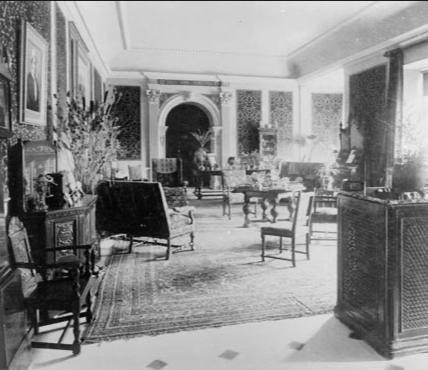
Above the porch, on the eastern front of Gayhurst House lies the Digby Room, now unnaturally high since it was once divided in two by a false ceiling. The creation of this secret room had been the work of a Jesuit lay brother, Nicholas Owen, and via secret passages in the wall, access was made not only to the cellars below but also to a room above, with the exit concealed behind the revolving hearthstone of a fireplace. In fact such measures were very necessary following the Reformation, when those not in harmony with the prevailing religion were in grave danger of execution. With Roman Catholics outlawed, and forbidden to practice, such persecutions then reached a zenith during the reign of Queen Elizabeth I, and as the purge continued so the homes of all the known Catholics were regularly raided and searched. Secret hiding places therefore became a necessity, and amongst the clergymen employed upon their construction was Nicholas Owen, the acknowledged master. For 16 years he worked all over the country, and after a day being kept busy on unimportant tasks, he would then emerge at night to begin his clandestine work. However, he was eventually caught when starved out from one of his own hiding places, and he subsequently died under torture in the Tower of London. Of all the secret places in Gayhurst House, in recent years only a part of a passage in one of the cellars remained, for during the tenancy of the House by Lord Carrington, Lord Lieutenant of the county, the ceiling of the Digby Room was removed in the 1860s, and the passages filled with tons of rubble. Yet the House again acquired a secretive role during World War Two, when it housed Wrens engaged on the code breaking activities of Bletchley Park. They worked eight hour shifts in a brick built hut in the grounds, yet even this rural seclusion was not safe from enemy attentions, for the vicinity was bombed on August 2nd, 1940.